Last verified October 3, 2026 for the direct-video versus USB-switch decision path and source review; September 9, 2026 for the remaining source set · Published September 9, 2026
Two Laptops, One Monitor, One Keyboard and Mouse: 4 Ways to Share One Desk
If you have two laptops, one monitor, and one keyboard and mouse, do not start by buying a large KVM dock. With only one shared display, the simplest setup is often to keep each laptop connected directly to a different monitor input and switch only the keyboard and mouse.
Use this order:
Check whether the monitor already has two usable inputs.
Check whether your keyboard and mouse already support multiple computers.
If not, add a small USB switch for the peripherals.
Move to a KVM only when you want video and USB to switch together.
Consider a KVM dock only when you also need docking, charging, Ethernet, or other laptop expansion.
That order keeps the video path simple and avoids buying functions you do not actually need.
Quick decision table
Your situation
Best starting point
Why
Monitor has two inputs and your keyboard/mouse already switch hosts
Keep existing gear
You may need no new hardware
Monitor has two inputs but ordinary USB keyboard/mouse
Monitor inputs + USB switch
Keeps video direct and switches only peripherals
You want one button to change monitor + keyboard + mouse
Single-monitor KVM
Coordinates video and USB switching
Your monitor already has a built-in KVM
Use the monitor KVM first
It may replace a separate switch box
A laptop also needs charging, Ethernet, ports, and one-cable desk connection
Evaluate a KVM dock
Combines docking and switching, with more compatibility checks
Employer-managed laptop blocks software or unapproved devices
Prefer the simplest permitted hardware path
Avoid depending on software or unsupported device installs
You switch only occasionally
Manual monitor input + existing gear
Another switching layer may not be worth adding
The handoff test: count what has to move
The question is not simply whether two computers can use one monitor. It is whether each handoff must move video, keyboard and mouse, or both at the same time.
What changes when you switch?
What you normally press
Starting architecture
Only the picture
Monitor input control
Keep both computers connected to separate monitor inputs
Only keyboard, mouse, or other USB devices
Peripheral channel button or USB-switch button
Multi-device peripherals or a USB sharing switch
Picture and USB devices together, many times a day
One verified KVM or built-in-monitor-KVM control
Single-monitor KVM, or the monitor's documented KVM path
A monitor input selector does not move the keyboard and mouse. A USB sharing switch does not move the picture. If the monitor and the USB switch are separate boxes, expect two deliberate actions: select the visible computer, then give that computer the peripherals.
Choose a KVM only when reducing those two actions to one is the job to solve. That one-action result depends on the exact wiring: both computers' video and USB paths must reach the KVM, or the monitor's manual must say that its KVM links the selected video source to the correct USB upstream path.
This distinction prevents the common wrong purchase: a USB switch is a good fit for direct video plus shared keyboard and mouse, but it cannot replace a KVM for someone who expects the screen to follow the USB button. For a deeper product-category comparison, see KVM Switch vs USB Switch: What Each One Actually Changes.
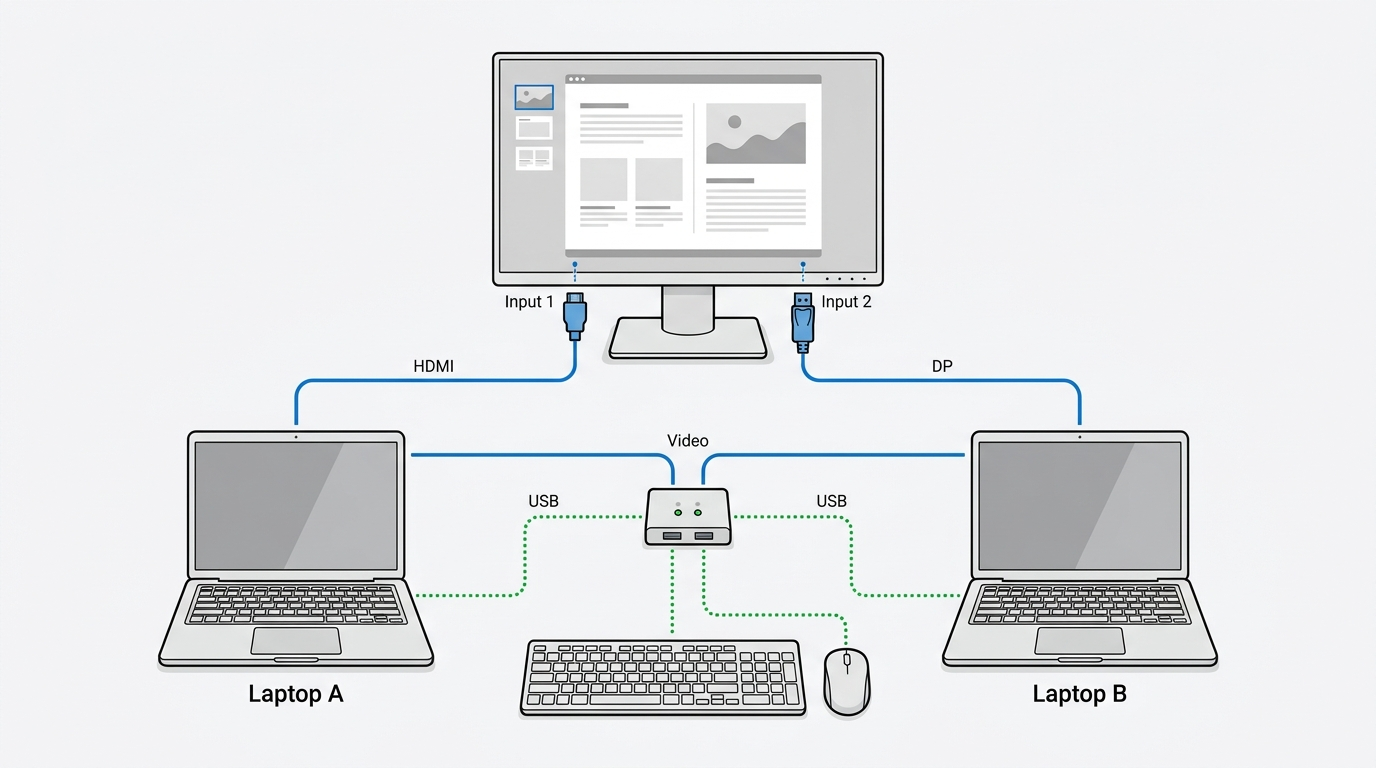
Option 1: Use the monitor’s two inputs and switch only USB
This is the first architecture to check because it separates two different jobs.
Video path:
Laptop A ── HDMI / DisplayPort / USB-C video ──> Monitor input 1
Laptop B ── HDMI / DisplayPort / USB-C video ──> Monitor input 2
Keyboard and mouse path:
Keyboard ─┐
Mouse ────┼─> USB sharing switch ──> Laptop A / Laptop B
Other USB ┘
The monitor changes which laptop you see. The USB switch changes which laptop owns the keyboard and mouse.
That means the USB switch does not need to understand HDMI, DisplayPort, refresh rate, HDR, or the laptop’s display protocol. Current UGREEN USB-sharing documentation makes the boundary explicit: its two-computer USB switches are for data/peripheral sharing and do not carry monitor video. SABRENT’s USB-SW30 is another exact category example: two computers share USB devices through a push-button USB 3.0 switch, with data rates up to 5Gbps.
This architecture is especially attractive when the monitor already has, for example, DisplayPort for one laptop or dock and HDMI/USB-C for the other.
First check whether you even need the USB switch
If your keyboard and mouse already support multiple hosts, use that feature first. Some peripherals can remember more than one Bluetooth or receiver connection and switch channels with a button.
Do not assume that every Bluetooth keyboard or mouse is multi-device. Check the exact model. But if the feature is already there, the result may be:
Buy Nothing.
The tradeoff is that you may need to change the monitor input and the peripheral channel separately. For a desk that changes computers once or twice a day, that may be perfectly acceptable.
SABRENT USB-SW30 is one hardware example for this peripheral-only architecture. It fits when monitor video stays on the existing direct connections and only USB peripherals need to move between the two laptops. It is not a KVM and does not replace the monitor-input switching path.
Disclosure: SetupMeld may earn a commission if you purchase through links on this page, at no additional cost to you. Product inclusion is based on compatibility with the setup described, not commission rates.
Laptop A video + USB ──┐
                       ├─> KVM ──> monitor + keyboard + mouse
Laptop B video + USB ──┘
Pressing the KVM’s button or hotkey changes the selected computer’s video and USB together.
This is the better fit when the inconvenience is not the cables themselves but the repeated sequence of:
change monitor input;
change keyboard/mouse host;
confirm the right computer owns the USB devices.
A KVM can turn that into one action.
But “single-monitor KVM” is a category, not a compatibility verdict. Verify the exact model for:
the video connector each laptop can supply;
the monitor connector you want to use;
target resolution and refresh rate;
HDR or variable-refresh features if they matter;
USB port count and speed;
keyboard/mouse or receiver compatibility;
EDID/display reconnect behavior if desktop rearrangement matters;
switching method;
charging only if the exact KVM documents it.
Do not assume a KVM will reduce video quality merely because it is a KVM. Current exact products exist with documented 1440p/144Hz and higher modes. The correct question is whether this KVM, these cables, these laptop outputs, and this monitor mode match end to end.
Option 3: Use the KVM already built into the monitor
Before adding another box, check the monitor manual.
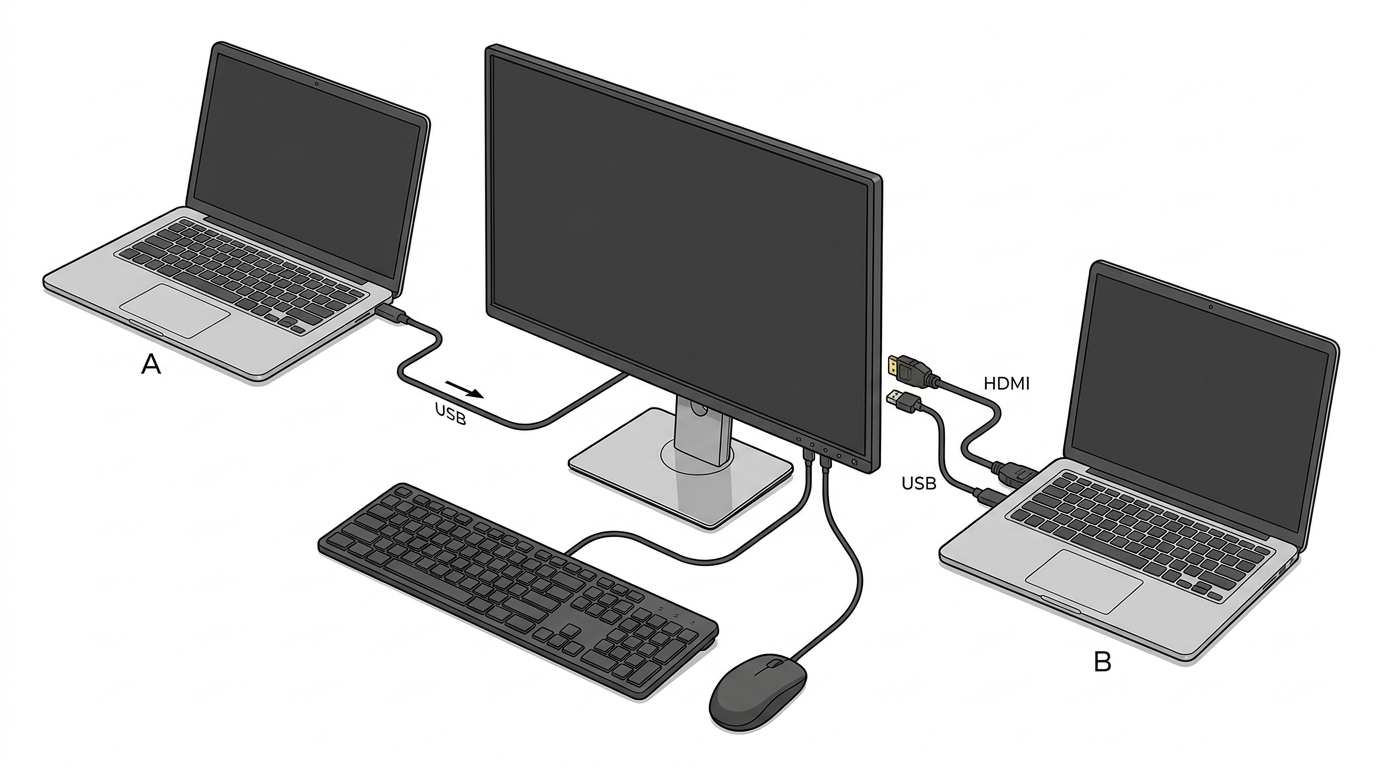
Some monitors have their own USB hub plus a built-in KVM. In that design, the monitor handles both the active video input and which computer owns the keyboard and mouse connected to its downstream USB ports.
Dell’s current KVM guidance shows the important wiring rule: both computers need a video path, and both need a USB upstream data path to the monitor. When one computer uses USB-C for both video and USB, the second computer may use HDMI or DisplayPort for video plus a separate USB upstream cable.
A typical layout looks like this:
Laptop A ── USB-C video + USB data ───────> Monitor
Laptop B ── HDMI/DP video ────────────────> Monitor
Laptop B ── separate USB upstream ────────> Monitor

Keyboard + mouse ──> Monitor USB downstream ports
ASUS documents the same basic pattern on the ProArt PA278CGRV: one host can use USB-C with DisplayPort Alt Mode, while the other uses HDMI or DisplayPort for video plus a separate USB upstream connection. Its Auto KVM then links the monitor’s peripheral routing to the selected source.
Why this can be the cleanest one-monitor setup
If your monitor already has the feature, a built-in KVM can mean:
no external USB switch;
no external KVM box;
fewer visible cables on the desk;
one place to manage the active source.
But do not replace a good monitor just to remove a small USB switch unless the monitor upgrade is useful for other reasons too. Existing-device-first still applies.
Also verify whether the KVM can be configured through the monitor’s own OSD. Dell, for example, documents OSD configuration as well as its management software. That distinction matters when one laptop is employer-managed and custom software cannot be installed.
Option 4: Use a KVM dock only when you need dock functions too
A KVM dock combines switching with functions such as:
USB-C laptop connection;
charging;
Ethernet;
extra USB ports;
audio;
display output;
sometimes multiple displays.
That can make a desk look cleaner because one laptop may connect with one USB-C cable. It can also make compatibility harder because one device now has to satisfy the laptop’s video, USB, power, operating-system, and switching requirements at the same time. Check those requirements in the KVM-dock compatibility matrix for laptop video, monitor, USB, charging, and switching limits.
For a one-monitor desk, ask what the dock is solving that a monitor input plus USB switch cannot.
A KVM dock becomes reasonable when the answer is specific, such as:
the work laptop needs Ethernet and several USB devices every day;
you need meaningful USB-C charging at the desk;
the laptop does not have a convenient direct monitor output;
one-button switching is important enough to justify more complex hardware.
If the only requirement is “use the same monitor, keyboard, and mouse,” a full KVM dock is often more device than the problem requires.
What if one laptop is locked down by work IT?
A work laptop can change the architecture decision.
If company policy prevents installing software, avoid designing the desk around software-only keyboard/mouse sharing or a dock that requires an unapproved graphics driver.
Hardware switching can reduce software dependence, but it is not a guarantee that every device is permitted. Microsoft documents that administrators can allow or prevent device installation on managed Windows computers by device ID, instance ID, or device class. Company policy therefore remains the authority.
Do not disable security software, bypass MDM rules, or weaken device controls just to make a shared desk more convenient.
A practical order is:
Use a monitor input the work laptop already supports.
Keep the laptop’s approved charger if Power Delivery is uncertain.
Use approved standard keyboard/mouse hardware.
Add a simple hardware USB switch only if the organization permits the attached devices.
Ask IT before depending on a driver-based dock, unusual USB device, or software KVM.
For a managed laptop, simpler can be more compatible.
If your peripherals cannot switch hosts, the next-smallest change is usually:
existing monitor inputs + USB switch.
That keeps the monitor and video cables you already own and adds only the missing peripheral-switching function.
Do not interpret this as a permanent price ranking. The point is architectural: you are buying one smaller function instead of replacing the monitor or adding a box that also handles video and docking.
Which setup uses the fewest cables?
If the monitor already has a built-in KVM and a full-function USB-C port for one laptop, that can produce the cleanest desk with the fewest extra boxes.
A compatible KVM dock can also reduce visible laptop cabling, especially when it supplies charging and ports over one host cable.
But fewer cables does not automatically mean fewer compatibility conditions. A simple monitor-input + USB-switch setup may have more separate cables while being easier to understand and troubleshoot.
Which setup is most convenient?
If you switch many times per day, coordinated switching matters more.
Choose an exact KVM when you want the monitor, keyboard, and mouse to move together in one action.
Choose an exact KVM dock when you also need laptop docking and charging in that same action.
If you switch once in the morning and once after work, the manual monitor-input + USB-switch path may already be convenient enough.
Bottom line
For two laptops and one monitor, start smaller than you think.
Use the monitor’s existing inputs first. If your keyboard and mouse can already switch between computers, keep them and buy nothing. If they cannot, a USB sharing switch can solve only the missing peripheral problem while leaving video direct.
Move to a KVM when one-button video + USB switching is the actual requirement. Use a built-in monitor KVM before adding another box if your monitor already supports the correct two-host wiring. Choose a KVM dock only when docking, charging, Ethernet, or other laptop expansion is also part of the problem.
If your second display becomes part of the requirement later, the architecture changes. Continue with Two Laptops, Two Monitors, One Keyboard and Mouse rather than assuming the one-monitor answer scales automatically.
SABRENT — USB-SW30 USB 3.0 Sharing Switch https://sabrent.com/products/usb-sw30
Verifies two-computer USB-device sharing, push-button switching, plug-and-play operation, and up to 5Gbps data rate for the exact switch.
Public user-report context — r/ultrawidemasterrace original comment
The commenter describes keeping direct display paths from a PC and a laptop dock to an ultrawide while a USB switch moves a keyboard, mouse, webcam, and headset. This is a traceable example of the two-action architecture, not a specification or a compatibility conclusion: the complete host and device models are not supplied.
Public user-report context — r/buildapc original comment
The commenter describes two monitors kept on direct video connections and a USB switch for shared peripherals, with separate monitor-input changes. It is retained as a weak, model-incomplete context report only; it does not establish that a particular computer, monitor, or switch will work.
No hands-on testing is claimed. Exact laptop ports, monitor inputs, cables, USB devices, employer policy, and product revisions still control the final compatibility result.